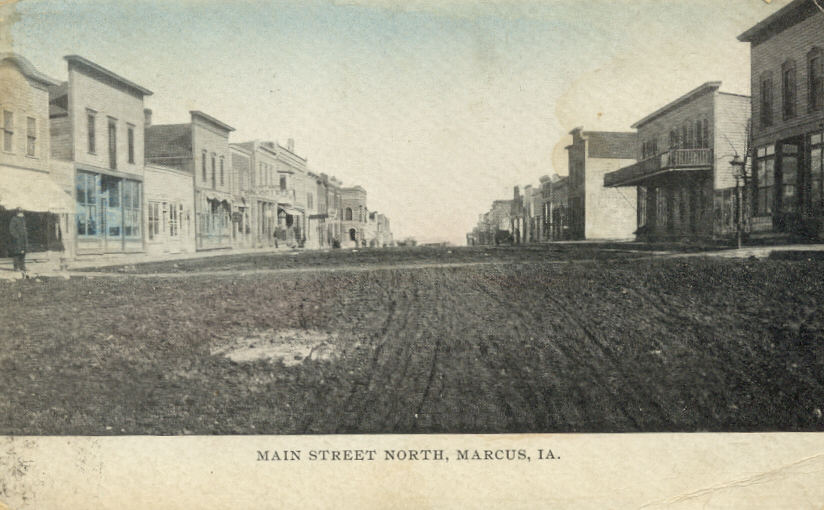
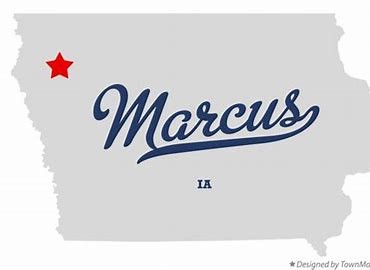
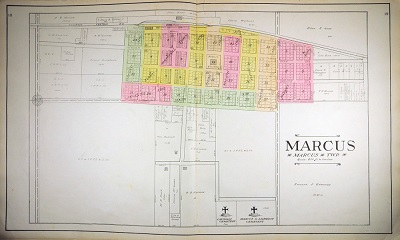
Marcus in 1878
The village of Marcus, on the western limits of the county, is the
second most populous in Cherokee. It is located on a sightly eminence,
surrounded by gently sloping prairie on all sides. There are no bluffs
or broken lands within miles of it, the country around being an
uninterrupted unbroken meadow, with its face somewhat diversified by
swelling lines as if heaved from the bosom of a prairie ocean.
Marcus
has made remarkable growth within the past two years. Then it had but
one store and its lumber yard, now it has 11 stores of various kinds, 3
hotels, 2 lumber yards, 2 elevators, 2 blacksmith shops, 1 broom
factory, 1 wagon shop, 1 harness shop, 1 coal yard, 2 land agencies, a
good school house, a public hall, a Masonic society, an Odd-Fellows
society, and three church organizations, with the church.
For
some time past immigrants have been pouring in at a lively rate in and
around the village. There is a large colony of Norwegians and Germans
settled around its vicinity, hard working, honest people who are fast
transforming the beautiful prairie into pleasant and peaceful and happy
homes. A few short years ago, Marcus seemed a mere spot in a boundless
expanse of tenant less prairie; now houses can be counted all over the
prairie as far as the eye can reach, and when one thinks of what the
village was then compared to its well built streets of today, it seems
almost a dream, and an impossible one at that.
Many of the
buildings are really good and substantial. The Wilmot Hotel would pass
for a likely home for the traveler in any ordinary town, and is inside
all that its appearance would indicate. The elevators of Mr. Gund and
J. Clarkson, are well built and commodious, the lumber yards of Jackson
and Wilmot fully supplied, and the stores of Hyndman, Weaver &
Sheldon, Ricker & Hiltgen, & c, are well stocked and
commodious.
Mr.
Beck has a fine hardware store and manufactures wagons, buggies,
&
c. The broom factory of Mr. Day is quite an institution, employs three
hands and turns out 150 dozen brooms per month. The Marcus broom has
gained a reputation and is fast displacing all others in the
neighboring markets.
Dr. Failing has a splendid drug store and in addition administers to
the temporal necessities of the indisposed.
Mr.
Clarkson runs a feed mill for the accommodation of the farmers, and I.
M. Jackson supplies building materials at low rates. R.
Wilmot
has the principal hotel, A. H. Zwright is postmaster, and B. H. Wilmot
the conveyancer of the town. Mr. Hardy is notary public. Like all other
western towns, Marcus has a good school house. The place is
sufficiently metropolitan to afford all the varieties of lie, literary
societies, glee clubs, revivals, dances and other amusements. It is in
fact a gay, lively place, with a big body and a much bigger heart.
The
railway company does a good business at Marcus. The receipts for the
past year being unusually large. The shipments of grain and stock is
what gives Marcus its value as a shipping point, and as the land around
it is not one-fourth settled upon, the future of the place is certainly
bright. Its location is fortunate for its future growth, occupying a
central position between Le Mars and Cherokee, affording sufficient
tributary territory to nurture and sustain a town of 2,000 inhabitants.
During the past summer, several land viewing excursions, gotten up by
the I.C.R.R., had Marcus for their terminal point, a great many saw the
pretty town and the magnificent country around it, carrying back to
Illinois pleasant remembrances of the smartest and prettiest village
between Chicago and the Missouri River.
Source:
History of
Cherokee County published by Cherokee County Historical Society. (
Their source: Cherokee Times, January 1878)
|
Marcus is in
Marcus Township
The first building was erected in 1871
The town was incorporated on
15 May 1882
|
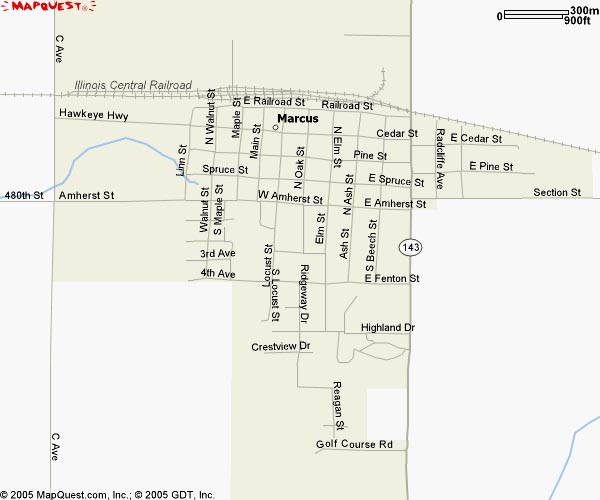
Map of Marcus
(Click image to enlarge)
|
Link to
Marcus Wikipedia
(off-site)
|
|