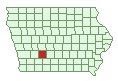
The territory embraced in congressional township 76, range 33, is organized into a civil township under the name of Eureka.
This is one of the latest settled sections of the county, and in 1873 had but a population of sixty-eight. Within the last decade it has, however, largely increased and even in 1880 is reported as having five hundred and six inhabitants. The surface of the land is very uneven, but not so rough as to destroy its adaptability for agriculture. In fact, it is doubtful whether there is one foot of it that cannot be utilized for some purpose. The soil is a rich, warm, black, sandy loam, that yields readily a rich return to the enterprising and industrious tiller of the ground.
The township has an abundance of clear running streams that drain it thoroughly, and afford an unlimited supply of most excellent water for stock purposes. Chief among these watercourses are the Middle Nodaway river, Kine Mile creek and several affluents of each. The Middle Nodaway enters the township on the north line of the northwest Quarter of section 6, and flowing at first southerly through sections 6, 7, 18 and 19, changes its course to a southeasterly one, and crosses sections 29, 32 and 33, making its exit on the south line of the latter. Nine Mile creek fertilizes with its waters, sections 1, 11, 12,13, 14, 22, 23, 27 and 34.
Besides these two numerous smaller rivulets and creeks are to be found in all directions. There is little or no natural timber within the limits of Eureka, but its proximity to Jackson, that possesses so much, makes this of little moment.
SETTLEMENT
The first to settle in what is now Eureka township were Henry and Nicholas Henning, in 1860. They purchased the land on section 31, in this township, in 1857, but did not move on it until the year as above stated, although they improved and cultivated it. Click here to read their biographies.
For many years these were the only settlers in Eureka township, and in 1867, 1868 and 1869 when they did begin to come in they came so rapidly that it is almost impossible to tell the exact order of their coming. Among the older settlers and more prominent men of the township are the following: Darwin I. Schenck, Marx Hell, Christian and David Eshelman, Fred H. Cears, Charles E. Schenck, Andrew J. Kingery, Albert Hadley, John J.Stinman, Ferdinand A. J. AVarner, E. M. Smith, Lewis Daniels.
ORGANIZATION
In the summer of 1870 the township was set off from Jackson, of which it had formed a part. The name, it is said, was suggested by J. W. Stinman, on account of finding some indications of coal within its borders. The first officers were as follows : James Tippin, G.W. Snyder, Sr., and Orlando Howe, trustees; John J. Stinman, clerk; B. F. Jones, justice; John Snyder, constable; Fred H. Cears, assessor; Henry Henning, road supervisor.
ITEMS
The Henning brothers, as before stated, broke the first ground in the township. They planted the first corn in 1859 and sowed the first wheat in 1860. They set out the first orchard in 1869. Henry Henning erected the first frame house in the township on section 31 in1860.
A round log house was constructed on section 33 by Miniture Jones in the summer of 1856. This was the first house in the township.The first marriage of a resident of this township was that of Nicholas Henning to Eliza Little on February 15, 1868. The ceremony was performed by Judge N. S. Taylor at Fontanelle. The first to be married after the township had been organized were Fred H. Cears and Emma Trowbridge. Rev. F. A. Goodrich spoke the words of union on March 10, 1872. The first deaths were those of two brothers, named Imus, about Christmas, 1859, who were frozen to death. The first religious services were held at the old Jones schoolhouse by Reverends Peet and Thomas about 1859. The former was a Congregationalist and the latter was a Methodist.
Eureka Cemetery was surveyed in the fall of 1878 and originally contained about three acres of ground. It is located upon the northwest quarter of the northwest quarter of section 22. Nancy Daniels was the first to be interred, having been buried a few days previous to the survey.